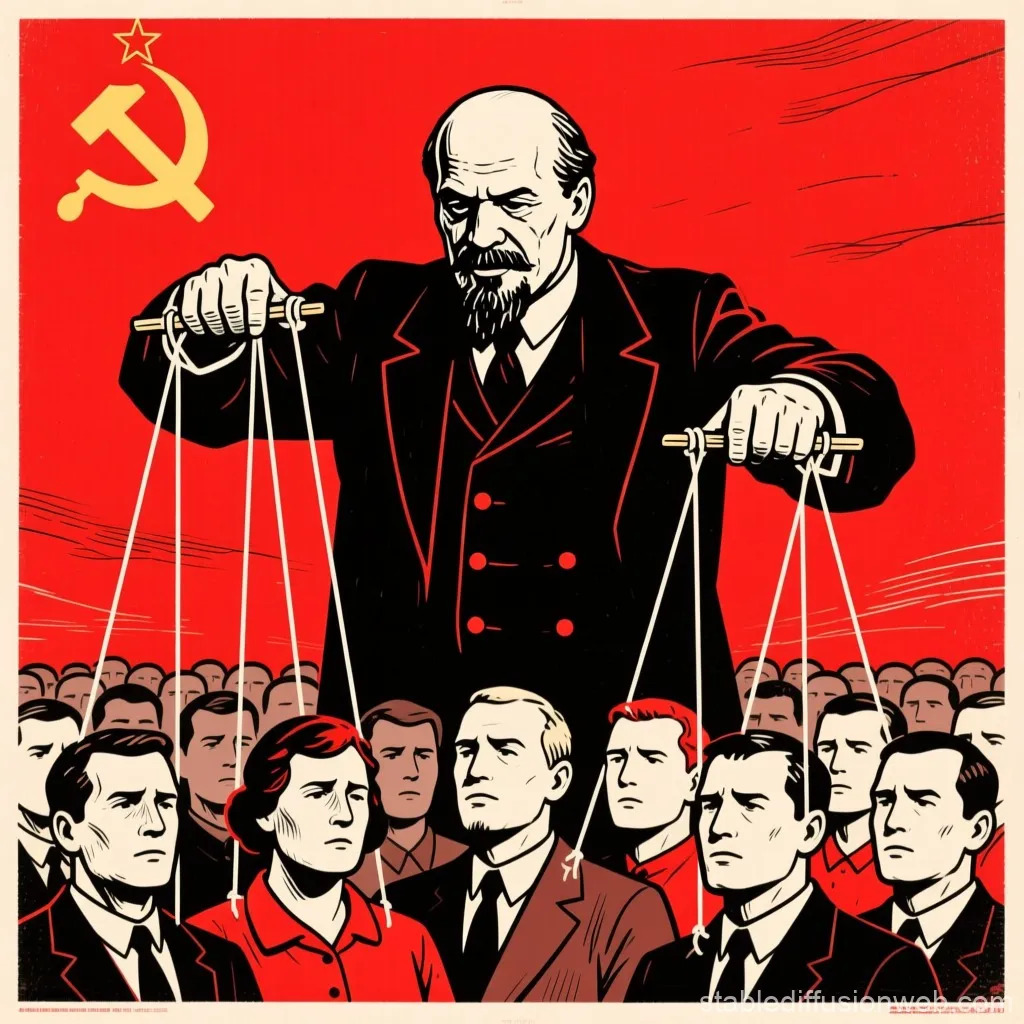
Capitalism will soon collapse. Global debt has reached astronomical proportions, and the global economy will be unable to withstand the interest payments. People who have realized the limitations of capitalism seek an alternative system, perhaps communism. However, we must remember the horrors of communism. Communism executed or murdered as many of its own people as the death toll from World War I and World War II combined. While the combined death toll from World War I and World War II was 100 million, 50 million were killed in executions and famines under Mao Zedong, and 30 million were killed in executions and intentional famines (the Holodomor) under Lenin and Stalin. It is well known that when Hitler invaded the Soviet Union, the Soviet casualties were high because most of the Soviet professional soldiers had been executed and only amateur soldiers remained. Pol Pot executed 2 million people, one in three Cambodian citizens. So why did communism execute so many of its own citizens? While killing an enemy in war is intuitively understandable, executing large numbers of one's own citizens in peacetime is difficult to comprehend. An even more important question is why such mass executions were possible.
First, a brief overview of communism: Marx created it as a counter-ideology to capitalism after the Industrial Revolution. Working conditions at the time were harsh and inhumane, with 12- to 16-hour workdays commonplace. Even children between the ages of 5 and 10 worked, there was no compensation for injuries, and wages were minimal enough to live. Marx therefore wrote "Das Kapital" to arm workers with theory. As its title suggests, "Das Kapital" is a book about capital, or money, and it contains many sharp observations that are truly valuable weapons for workers. The society that communism aims for is a classless, equal society. Marx believed that communalizing land and the means of production would eliminate classes, and with class abolition, conflict would disappear and there would be no rulers. He also believed that religion was an escape from reality, and that revolutions would inevitably be violent because capitalists would never voluntarily give up their power.
Lenin was the one who put Marx's ideas into practice. Taking advantage of the collapse of the Romanov dynasty due to mismanagement during World War I, Lenin led a small group of supporters to a successful revolution. Even after losing the election, he maintained power through military force and implemented communist policies such as nationalizing industry, transportation, and banking, confiscating land from large landowners and distributing it to peasants, establishing a free education system, and liberating women. The goal of a communist revolution was to overthrow the capitalist class. If that were the case, the revolution should have ended when Lenin took power and nationalized factories and other facilities. However, Lenin did not end the revolution. Lenin said, "Counter-revolutionaries are everywhere," and established the political police, commonly known as the Cheka.
The Cheka's mission was to "monitor and eradicate counter-revolutionary and sabotage plots and actions." It also had the authority to arrest, imprison, and execute suspects without a court decision. It was a violent organization above the law. But what exactly was "counter-revolutionary"? There was no clear definition. Anyone whom Lenin considered an enemy could be labeled a "counter-revolutionary" and executed. This included factory owners, merchants, wealthy peasants, political opponents, clergy, and intellectuals. The 1992 Russian film "The Chekist" depicts the assembly-line execution process. Lenin's goal was not revolution but the establishment of a dictatorship, but the Soviet people were powerless amid the rapid changes in society. Some celebrated the executions, some resisted, but most simply watched.
No other ideology is as starkly different from its substance as communism. Lenin replaced the ideals of communism with the realization of dictatorship. Communism's denial of private property allows it to deprive people of their rights and place them in a weak position. The denial of class is an excuse for one-party dictatorship. The denial of God allows the dictator to become God himself. And what made Lenin so devilishly clever was his focus on the cutting edge of psychology at the time. Here's a story:
In October 1919, according to legend, Lenin paid a secret visit to the laboratory of the great physiologist I. P. Pavlov to find out if his work on the conditional reflexes of the brain might help the Bolsheviks control human behaviour. 'I want the masses of Russia to follow a Communistic pattern of thinking and reacting,' Lenin explained. 'There was too much individualism in the Russia of the past. Communism does not tolerate individualistic tendencies. They are harmful. They interfere with our plans. We must abolish individualism.' Pavlov was astounded. It seemed that Lenin wanted him to do for humans what he had already done for dogs. 'Do you mean that you would like to standardize the population of Russia? Make them all behave in the same way?' he asked. 'Exactly', replied Lenin. 'Man can be corrected. Man can be made what we want him to be'.
『A People's Tragedy: The Russian Revolution: 1891-1924』
Lenin's knowledge of Pavlov's theory convinced him that the human brain could be manipulated. Pavlov's dogs were a form of brainwashing through conditioning. By constantly playing a bell when feeding a dog, the dog would begin to salivate at the sound of the bell. Lenin linked the word "counterrevolution" with the Cheka, conditioning the people so that their brains would freeze with fear whenever they heard the word. Thus, the Soviet people became completely unable to resist the word "counterrevolution." What's strange about the movie "The Chekist" is that the people about to be executed barely resisted at all, and in fact, some even appeared to willingly accept their execution. This is the horror of mind control. The Soviet people came to accept being labeled a "counterrevolutionary" and executed as a matter of course. What's even more diabolical about Lenin was that in addition to mind control of the people, he also adopted a system of informants. The informant system meant that anyone, not just Lenin, could label another person as a "counter-revolutionary" and have them executed by the authorities. This system, which allowed people to legally kill anyone they disliked, threw the Soviet people into panic. It was like the world of the cult movie "Battle Royale," where middle school students kill each other. Everyone around you is an enemy who might inform on you, and in order to survive, you must kill others before they kill you. Such a world once existed in reality.
Looking at Soviet society through a modern lens, modern people might think, "It's strange to execute people for such vague reasons as counterrevolution." However, at the time, anyone who had such doubts was the first to be executed. This is why Lenin executed clergy and intellectuals. This approach was the same in China and Cambodia, and Pol Pot in particular thoroughly executed anyone who could read. After Lenin's death and the rise of Stalin, the blame for policy failures shifted to ordinary people and led to their executions. Stalin executed factory managers, blaming sabotage for poor factory production. The more Stalin's political failures, the more citizens were executed, and tens of millions of Soviet people were killed in this way.
There are countless lessons to be learned from the history of communism. One example is that nationalizing the means of production, while seemingly just, was actually a means of disempowering the people. However, I will focus on the most important points here. If the combination of mind control and informant systems led to deaths comparable to those of World War I and World War II, then the enemy we must fear most is government-sponsored mind control. The constitution is a law that protects the people from the government, and this is precisely why freedom of thought is so important. When the government establishes a thought police, the people must expect that this will eventually lead to the murder of tens of millions of people. Reason and conscience are what protect people from mind control, and this is precisely why philosophy is such an important discipline.
Add new comment